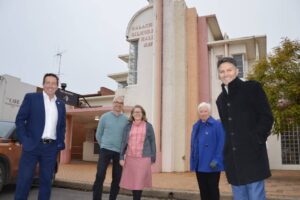

The National Trust Heritage Awards is New South Wales’ biggest celebration of outstanding practice in the field of heritage, recognising excellence in the conservation, protection, and interpretation of Aboriginal, cultural, built, and natural heritage over the past year.
We are thrilled to have been shortlisted as a finalist this year, and we will be attending the Awards ceremony at the heritage listed Doltone House in Pyrmont in mid-May!
There is also an opportunity for you to vote for the Malachi in the National Trust Heritage People’s Choice award and this is a good way to view all the other shortlisted projects. We are finalists in the Built Conservation category. As you can see, there is a lot of wonderful heritage work being accomplished across the state, but we’d love you to vote for us! Voting closes midnight, May 4.
The Malachi’s Story
Here is a taste of the Malachi Gilmore Hall’s story and the work we have done in recent years to conserve this amazing place.
Exploring the original intent of the architect
In 1936, a new hall for Oberon was commissioned by the Catholic parish priest, Father A. J. Gummer, and designed by the architectural firm Agabiti & Millane, with the involvement of young Italian architect Virgil Cizzio. Father Gummer, an admirer of Italian Art Deco, embraced a design influenced by Italian Rationalism – an architectural style that blended geometric simplicity with modernist ideals. The resulting hall was a strikingly progressive structure for regional NSW during the interwar period.

For nearly ninety years, the Malachi Gilmore Hall has stood as a cultural and architectural gem in the heart of Oberon. Built in 1937 by the local Catholic parish, the Hall quickly became the hub for community gatherings, dances and bi-weekly movie going.

Scope of restoration
Since purchasing the Malachi in 2017, the scope of conservation works completed include an integrated development application with Building Code re-classifications, achieved the compliances for fire regulations and accessibility for a modern-day Assembly Hall, built new capital works of patrons’ amenities, greenroom for performers and a BCA Class 4 managers’ accommodation. The extensive repair and repaint work to the exteriors and interiors are guided by our 2022 Conservation Management Plan. We’ve fitted out the auditorium with theatrical production equipment, creating a dynamic space for performances, arts events and gatherings. A central challenge in the Malachi project has been galvanising community support for the revitalisation of this cherished Oberon landmark, balancing heritage conservation with practical modern use.

The Façade & Pharos Pylon
The soaring glass brick and concrete column, known as the Pharos Pylon reflects the Ancient Age influence on the Malachi’s Italian architects. Externally, the concrete was expertly rendered with a cross-scratched base coat, followed by a textured green tinted finish. Specified to be unpainted, the reinforced concrete held well in the high-altitude, salt-free air. In 1987, a façade paint job of apricot and pink hues, perhaps chosen with the vibrant Miami-style Art Deco trends of the time, and interior painting over the plaster stucco led to moisture retention within the concrete. Today, this issue is resolved with specialist coatings that fully seal each concrete element, preventing water ingress. With a return to a single-color façade, the building’s striking form is now enhanced by dynamic shadows and bright contrasts, celebrating its original design.

External and interior paints were supplied by Artarmon-based Murobond, known since 1988 for its expertise in protective and decorative coatings. Finishes include Murolast Elastomeric Membrane, a custom colour of a heavy ivory in Pure Low Sheen for the façade, Aqua Glaze Pearl for the entrance canopy and stucco interiors, and Micaceous Bridge Paint for the steel windows and balustrades.
Perth-based company Cementaid (est 1946) provided advice on using the Everdure Caltite system to repair the disintegrated screeds on eleven formed concrete roofs. This system eliminates the need for applied membranes and allows for the creation of falls and formed gutters without adding extra weight.
Australian owned Norglass Weatherfast premium gloss enamel in Port Wine provides a theatrical and glamorous finish on the timber doors.
Conservation Works – critical repairs

Conservation Works – compliance items

Capital Works – Patron’s Amenities
In 1937, the Malachi was ill-equipped for patron’s amenities with a shed of dunnies out the back. This lack was mentioned in a Chief Secretary’s Dpt report in 1943. We have built compliant toilets in a space between the hall and the neighbouring Commonwealth Bank – achieved with the simple removal of one window and a clever layout.

Adaptive Reuse – Green Room and Class 4 residence
The Dress Circle originally featured wooden tiers accommodating 50 seats (no photos have been found) and provided access to the Bio Room. When the building was converted into wool store offices and a craft shop gallery, the mezzanine level was walled off from the auditorium and divided into two rooms. Now, with a new BCA Class 4 classification, this area has been repurposed as the Green Room and the managers’ residence—an essential component in ensuring the venue’s ongoing success.

Conservation Works – Equipping the Hall
With critical financial support from the NSW Government’s Office of Responsible Gambling and the Federal Government’s Live Music Australia, we have successfully reactivated the venue through the installation of extensive audio-visual production equipment. A chain-hoisted lighting truss, all-LED lamps, and a simple lighting desk allow the hall’s lighting system to be operated by volunteers.
Blessed with superb acoustics ideal for both acoustic music and spoken theatre, the auditorium is also equipped with a powerful 7.1 sound system, enabling film screenings and contemporary music performances. Sound mitigation elements have been thoughtfully installed with financial support from Sound NSW, and the entire hall has been rewired with efficient energy-saving measures.
The building’s fire protection system is fully in place and compliant with the Annual Fire Safety Certificate.